
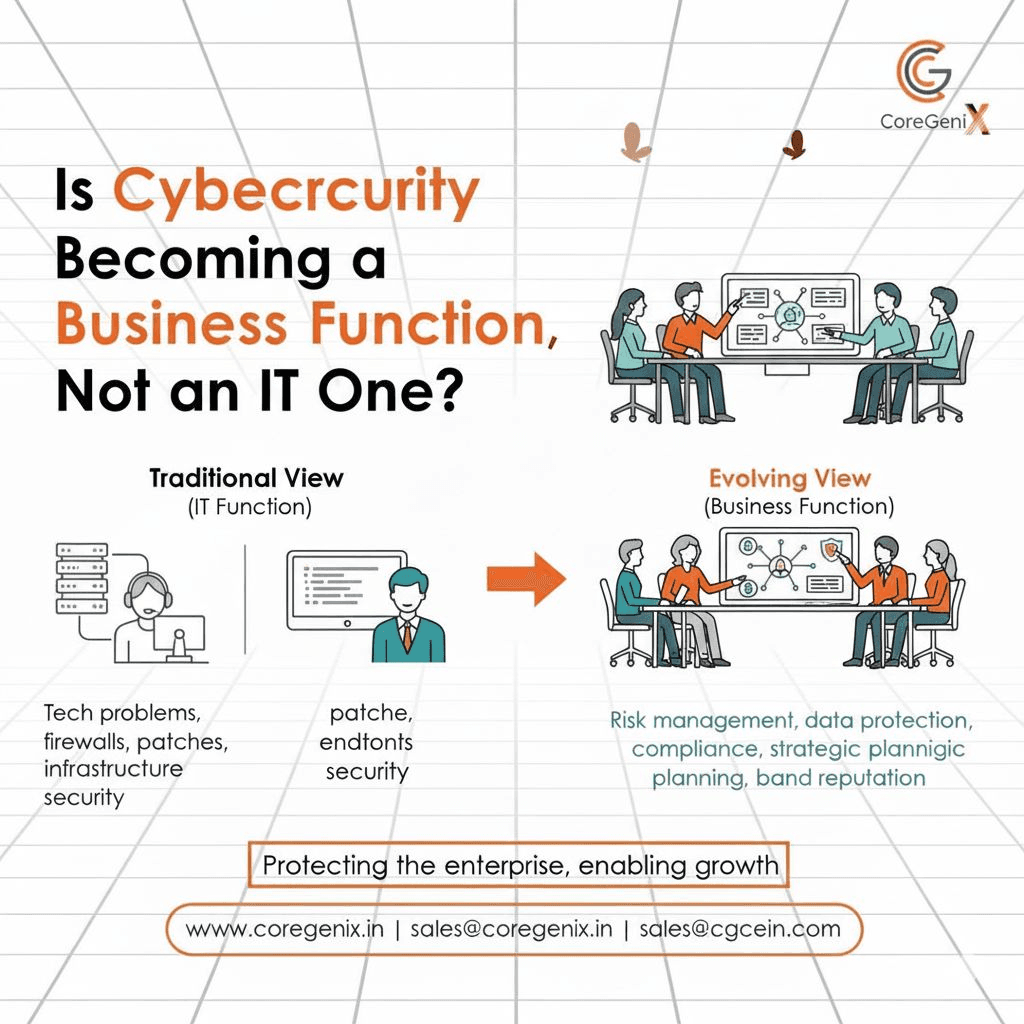
There's a quiet crisis unfolding in Indian boardrooms, and most decision-makers don't see it coming until it's too late. A ransomware attack. A misconfigured cloud server leaking customer data. A firewall that hasn't been patched in 18 months. These aren't hypothetical scenarios — they're headlines from last quarter.
There's a quiet crisis unfolding in Indian boardrooms, and most decision-makers don't see it coming until it's too late. A ransomware attack. A misconfigured cloud server leaking customer data. A firewall that hasn't been patched in 18 months. These aren't hypothetical scenarios. They're headlines from last quarter. India's digital economy is booming, and cybercriminals know it.
The Numbers Don't Lie
India's cybersecurity market generated revenues of USD 10.15 billion in 2025 and is projected to reach USD 38.7 billion by 2033, growing at a CAGR of 18.2% — well above the global average. That growth isn't just investment; it's a response to escalating threats. According to the DSCI India Cyber Threat Report 2025, India recorded 369 million distinct malware detections across 8.44 million endpoints in a single reporting period. Banking and Finance, Healthcare, and Hospitality are the most targeted sectors. The shift, security experts note, is from opportunistic attacks to targeted, sophisticated campaigns — meaning every business, regardless of size, is now a potential target.
The Managed Services Advantage: Why Businesses Are Outsourcing Security
For most Indian businesses, especially SMBs, building an in-house security team capable of handling today's threat landscape is expensive, time-consuming, and increasingly impractical. This is why Managed Security Services now hold the highest market share in India's cybersecurity landscape.
You get round-the-clock NOC/SOC coverage without the overhead of building one. You gain access to certified experts in VAPT, EDR/XDR, and compliance. You shift from reactive firefighting to proactive threat prevention. At CoreGenix, this is exactly the model we've championed for over 22 years, built for businesses that want enterprise-grade protection without enterprise-grade complexity.
Cloud Is the New Battleground: Is Your Infrastructure Ready?
The Indian cybersecurity market is rapidly shifting from infrastructure-based security spending to AI-powered, cloud-native security solutions. And yet, misconfigured cloud services remain the top vulnerability for Indian organisations. Cloud adoption without proper security architecture is like building a new office and forgetting to install locks on the doors.
The solution isn't to avoid the cloud — it's to secure it properly. That means Zero Trust architecture that verifies every access request, SIEM integration for real-time threat monitoring, Identity and Access Management to control who sees what, and Data Backup, DR, and BCP solutions to ensure continuity when — not if — something goes wrong. These aren't luxury add-ons. With the DPDPA imposing steep penalties for breaches, they are compliance imperatives.
OT Security: The Overlooked Frontier
Most conversations about cybersecurity focus on IT systems. But Operational Technology — the systems controlling manufacturing lines, utilities, and industrial equipment — is rapidly becoming a major attack vector. India's enterprise IoT market is accelerating, but security frameworks haven't kept pace. At CoreGenix, our IT and OT cyber security solutions bridge this gap, because a breach in your OT environment doesn't just compromise data. It can halt operations entirely.
The Bottom Line
If you're a CTO, IT Head, or business owner reading this, here's the one question that matters: does your current IT infrastructure protect your business at the pace at which threats are evolving? If you're not sure of the answer, that's the answer.
The threat landscape in India is not slowing down. The regulatory environment is getting stricter. And the cost of a breach — financial, reputational, operational — far exceeds the cost of prevention. At CoreGenix, we're here to make sure you never have to find that out the hard way.