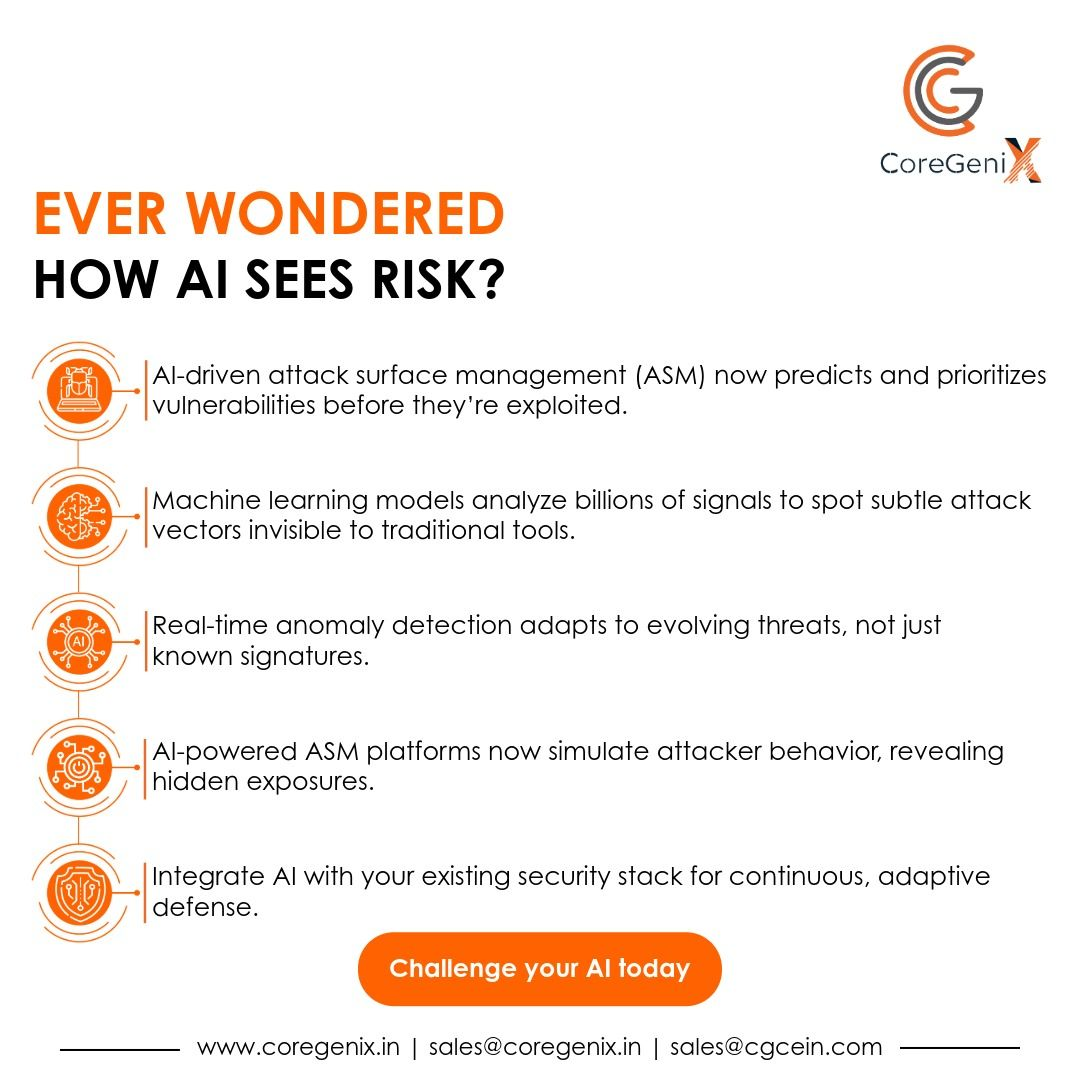
Ever wondered how artificial intelligence actually sees cyber risk?
Traditional security tools rely on known signatures, static rules, and historical attack data. AI changes this model completely. Instead of reacting to threats, AI learns how attackers think, predicts where risk will emerge, and prioritizes vulnerabilities before they are exploited.
This shift is redefining how organizations assess, monitor, and secure their digital environments.
Why Traditional Risk Assessment Falls Short
Most security programs still depend on periodic scans and rule-based alerts. These approaches struggle with:
- Unknown attack vectors
- Rapidly changing cloud environments
- Complex hybrid and multi-cloud infrastructures
- Alert fatigue caused by excessive false positives
Attackers do not wait for scan cycles. AI-driven security doesn’t either.
How AI Understands Risk Differently
AI evaluates risk as a dynamic, constantly evolving pattern rather than a static checklist.
Here’s how AI-driven Attack Surface Management (ASM) changes the game:
1. Predicting Vulnerabilities Before Exploitation
AI-driven ASM platforms continuously map your external and internal attack surface. They identify exposed assets, misconfigurations, and risky dependencies — then prioritize them based on real-world exploitability, not theoretical severity.
This allows security teams to focus on what attackers are most likely to target first.
2. Machine Learning That Sees What Humans Miss
Machine learning models analyze billions of signals across networks, endpoints, identities, and cloud workloads.
By correlating subtle behaviors across systems, AI detects attack patterns that traditional tools cannot see — including slow, stealthy, and low-noise threats.
3. Real-Time Anomaly Detection
Unlike signature-based detection, AI adapts continuously.
It identifies deviations from normal behavior in real time, even when there is no known indicator of compromise. This makes it especially effective against zero-day attacks and insider threats.
4. Simulating Attacker Behavior
Modern AI-powered ASM platforms simulate attacker paths.
They model how an adversary could move laterally, escalate privileges, and exploit chained vulnerabilities — revealing hidden exposure paths before attackers discover them.
Why AI Alone Is Not Enough
AI is powerful, but unmanaged AI can introduce new risks.
Bias in training data, opaque decision-making, and over-automation can create blind spots if AI is deployed without governance and validation.
This is why AI must be integrated thoughtfully into an organization’s existing security stack — supported by human oversight, context, and operational discipline.
AI-Driven Risk Management in Practice
At :contentReference[oaicite:1]{index=1}, AI-driven security is implemented as an enabler, not a black box.
Our approach focuses on:
- Integrating AI-driven ASM with existing SOC and SIEM platforms
- Validating AI insights through continuous monitoring and threat intelligence
- Reducing false positives while improving detection accuracy
- Aligning AI risk insights with Zero Trust security models
The goal is not just visibility — it is actionable, prioritized defense.
Seeing Risk Before Attackers Do
Cyber risk today is dynamic, fast-moving, and increasingly automated.
Organizations that rely solely on traditional tools will always be one step behind. AI-driven ASM allows security teams to see risk the way attackers do — and respond before damage occurs.
Challenge your AI today. Because attackers already are.