Attackers don’t scan for tools.
They look for what your tools overlook.
Modern enterprise networks are packed with security products — firewalls, EDR, SIEM, IDS, cloud security tools. Yet breaches continue to happen, not because organisations lack tools, but because attackers exploit the gaps between them.
The Real Problem: Security Blind Spots
Most security stacks were built in layers, not as a unified system. Over time, this creates blind spots such as:
- Unmonitored east–west traffic inside the network
- Over-permissive access between applications and services
- Legacy trust assumptions inside internal networks
- Static segmentation that doesn’t adapt to behavior
Attackers don’t fight your perimeter — they move quietly inside it.
Why Tools Alone Don’t Stop Modern Attacks
Security tools detect events. Attackers exploit relationships.
Once initial access is gained, attackers focus on:
- Lateral movement across workloads
- Privilege escalation through trusted paths
- Hidden communication between internal services
If these paths are not continuously validated and segmented, detection comes too late.
Closing the Gaps with AI, Zero Trust, and Microsegmentation
At :contentReference[oaicite:1]{index=1}, we don’t add more tools. We align intelligence, access control, and segmentation to eliminate blind spots.
1. AI-Driven Detection That Sees Behavior, Not Just Alerts
AI analyzes traffic patterns, identity behavior, and application communication to identify anomalies that static rules miss.
This allows threats to be detected early — before escalation.
2. Zero Trust Access as the Foundation
Zero Trust removes implicit trust from the network.
Every user, device, and workload is verified continuously based on identity, context, and risk — not location.
3. Adaptive Microsegmentation
Microsegmentation limits lateral movement by enforcing least-privilege communication between systems.
Unlike static segmentation, adaptive segmentation evolves with application behavior and risk signals — closing paths attackers rely on.
What Attackers See That You Might Not
Attackers look for:
- Overlooked service-to-service trust
- Unused but reachable network paths
- Identity permissions that were never reviewed
- Traffic your firewall was never designed to inspect
These are not tool failures — they are visibility failures.
Security That Reduces Exposure, Not Just Alerts
Effective network security in 2026 is not about adding another dashboard.
It’s about reducing attack paths.
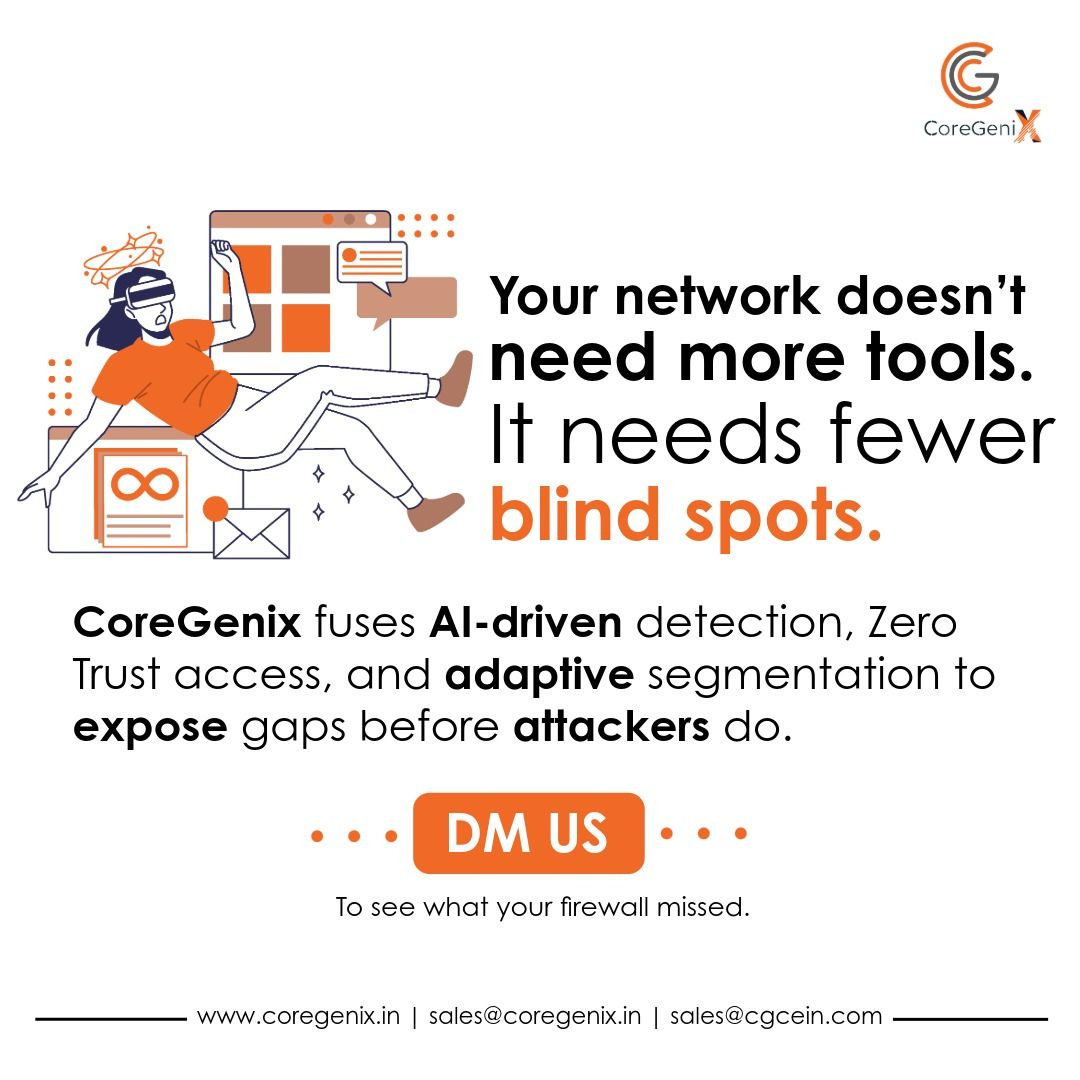
By aligning AI-driven detection with Zero Trust access and microsegmentation, CoreGenix helps organisations expose gaps before attackers do.
See What Your Firewall Missed
Your network doesn’t need more tools.
It needs fewer blind spots.
Ask us what you’re not seeing — before attackers find it.