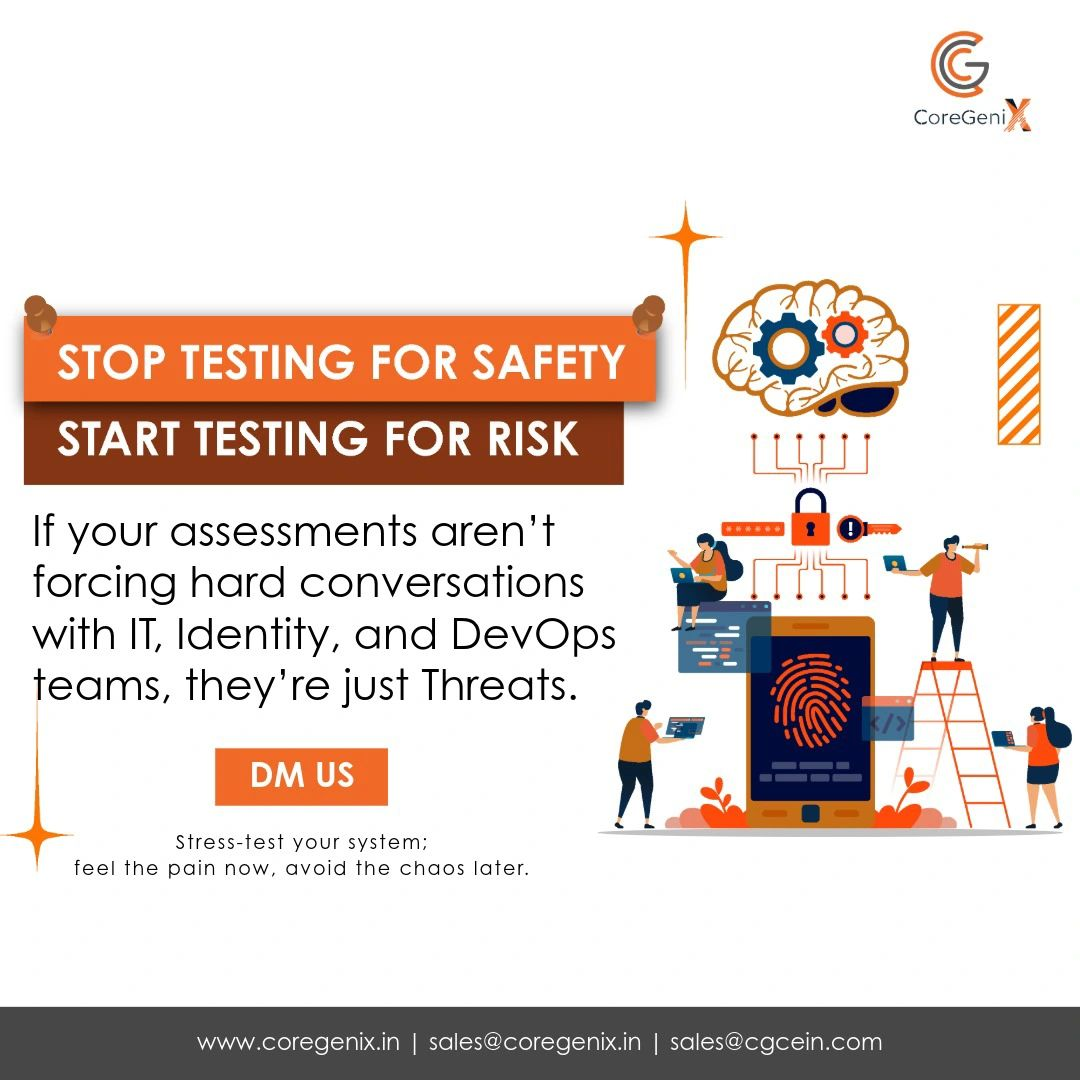
Most organizations believe they are secure because their assessments say “passed.”
But here’s the uncomfortable truth:
Safety is a checkbox. Risk is reality.
If your security assessments are not forcing hard conversations across IT, Identity, and DevOps teams, then you are not testing risk—you are just documenting assumptions.
Why Safety-Based Testing Fails Modern Enterprises
Traditional security assessments often focus on:
- Policy existence
- Control presence
- Compliance alignment
While important, these checks answer only one question:
“Do we have controls?”
They do not answer the question that matters most:
“What actually breaks when we are attacked?”
Risk-Based Testing Changes the Conversation
Risk-based security testing shifts focus from documentation to impact.
Instead of asking “Is this control enabled?”, risk testing asks:
- Can an attacker bypass identity controls?
- What happens if privileged access is abused?
- How far can lateral movement go?
- How fast can we detect and contain real damage?
This approach exposes gaps that compliance audits never will.
The Problem With “Passing” Assessments
Organizations that only test for safety often experience:
- False confidence in controls
- Siloed responsibility between IT, Security, and DevOps
- Delayed detection during real incidents
- High business impact when assumptions fail
Passing an audit does not mean surviving an attack.
What Risk Testing Actually Looks Like
At :contentReference[oaicite:1]{index=1}, risk testing is designed to simulate reality—not perfection.
1. Identity-Centric Risk Validation
We test how identity behaves under pressure:
- Privilege escalation paths
- MFA fatigue and bypass scenarios
- Conditional access failures
If identity fails, everything else follows.
2. DevOps & Cloud Misconfiguration Risk
Risk often lives where speed meets complexity:
- CI/CD pipeline exposure
- Secrets management gaps
- Over-permissive cloud roles
These are rarely caught in checklist-based audits.
3. Detection & Response Stress Testing
Risk testing answers uncomfortable but necessary questions:
- How long before alerts are noticed?
- Which alerts are ignored as noise?
- What actions are delayed due to unclear ownership?
Security fails quietly before it fails publicly.
Why Risk Testing Requires Hard Conversations
True risk assessments:
- Challenge assumptions
- Expose ownership gaps
- Force prioritization decisions
They create friction—because friction reveals truth.
If no one is uncomfortable during an assessment, risk is not being tested.
Risk Testing Is About Resilience, Not Fear
Risk-based testing is not about pointing fingers.
It is about answering one critical question:
“Can this system survive when—not if—something goes wrong?”
Organizations that test for risk recover faster, respond clearer, and suffer less damage.
Stress-Test Now. Avoid Chaos Later.
Cyber resilience is built before the incident—not during it.
At CoreGenix, we help organizations:
- Move beyond checkbox security
- Identify real attack paths
- Align IT, Identity, and DevOps around risk
- Reduce business impact before breaches occur
Feel the pain now—so you don’t feel the chaos later.