In cybersecurity, what you don’t review regularly often becomes your weakest link. Threats evolve constantly, configurations drift, and access permissions change—sometimes without notice. That’s why quarterly security audits are no longer just a compliance activity; they are a core pillar of cyber resilience.
At CoreGenix, we’ve consistently observed that organisations conducting structured quarterly control reviews experience fewer security incidents, faster response times, and stronger operational confidence.
Why Quarterly Reviews Matter More Than Annual Audits
Annual audits provide a snapshot in time. Quarterly audits, on the other hand, create a continuous security rhythm.
They help organisations:
- Detect misconfigurations before attackers do
- Reduce dwell time by improving detection readiness
- Validate that security controls are actually working
- Adapt quickly to new threats and infrastructure changes
Security is not static—and neither should your audits be.
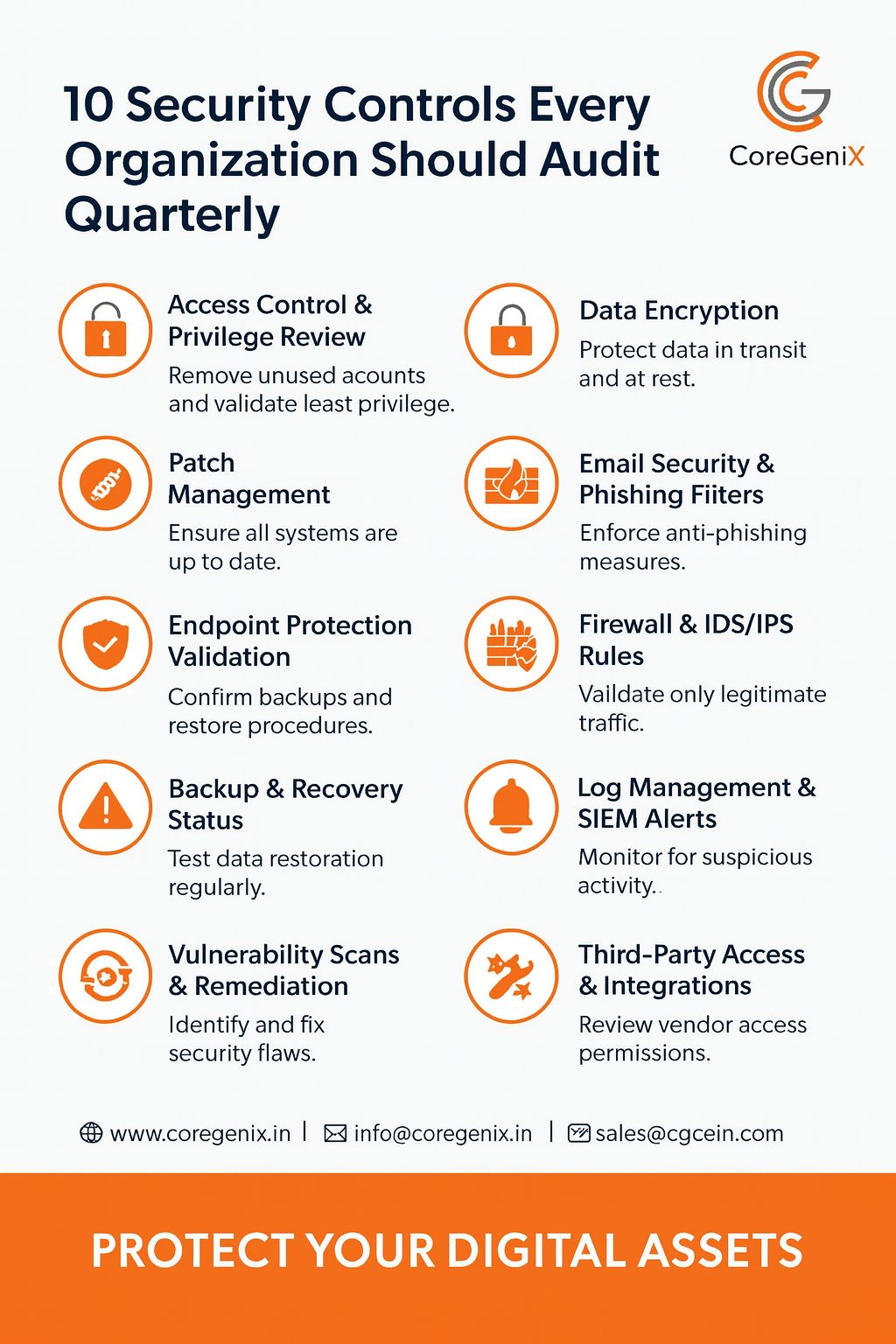
10 Security Controls Every Organisation Should Audit Quarterly
1. Access Control & Privilege Review
Remove unused and orphaned accounts, review admin privileges, and enforce least-privilege access across users and systems.
2. Patch Management
Ensure operating systems, applications, and network devices are updated with the latest security patches.
3. Endpoint Protection Validation
Confirm that antivirus, EDR, and file integrity monitoring tools are active, updated, and reporting correctly.
4. Backup & Recovery Status
Validate backup integrity and test restore processes to ensure data can actually be recovered during an incident.
5. Vulnerability Scans & Remediation
Run vulnerability assessments regularly and verify that high-risk findings are remediated—not just reported.
6. Email Security & Phishing Filters
Audit email security configurations and monitor phishing, spoofing, and impersonation attempts.
7. Firewall & IDS/IPS Rules
Review firewall policies and intrusion detection rules to ensure only legitimate traffic is allowed.
8. Log Management & SIEM Alerts
Verify that critical log sources are ingested, alerts are tuned, and security teams are notified of suspicious activity.
9. Incident Response Procedures
Simulate attack scenarios, test response workflows, and update incident playbooks based on lessons learned.
10. Third-Party Access & Integrations
Review vendor access, API integrations, and external connections to minimise third-party risk.
Automation Helps—but Validation Is Non-Negotiable
Automation improves efficiency, but it does not guarantee security.
Pro tip: Automate repetitive tasks such as scanning and patching, but always validate results. Automation amplifies speed—not assurance.
Security Is a Continuous Cycle
Effective cybersecurity is not a one-time implementation. It is a continuous cycle of:
- Assessment
- Improvement
- Adaptation
Quarterly security audits help organisations stay ahead of attackers while maintaining operational stability.
How CoreGenix Simplifies Quarterly Security Audits
At CoreGenix, we help organisations make security measurable and continuous through:
- Structured quarterly security assessments
- Automated control validation
- Real-time visibility across users, endpoints, and data
- Integrated SOC monitoring and response
The result is a security posture that evolves as fast as the threat landscape.
Make Security Measurable, Continuous, and Resilient
Quarterly audits are not about ticking boxes—they’re about building confidence.
Ready to strengthen your security posture?
Let CoreGenix help you turn periodic audits into continuous cyber resilience.