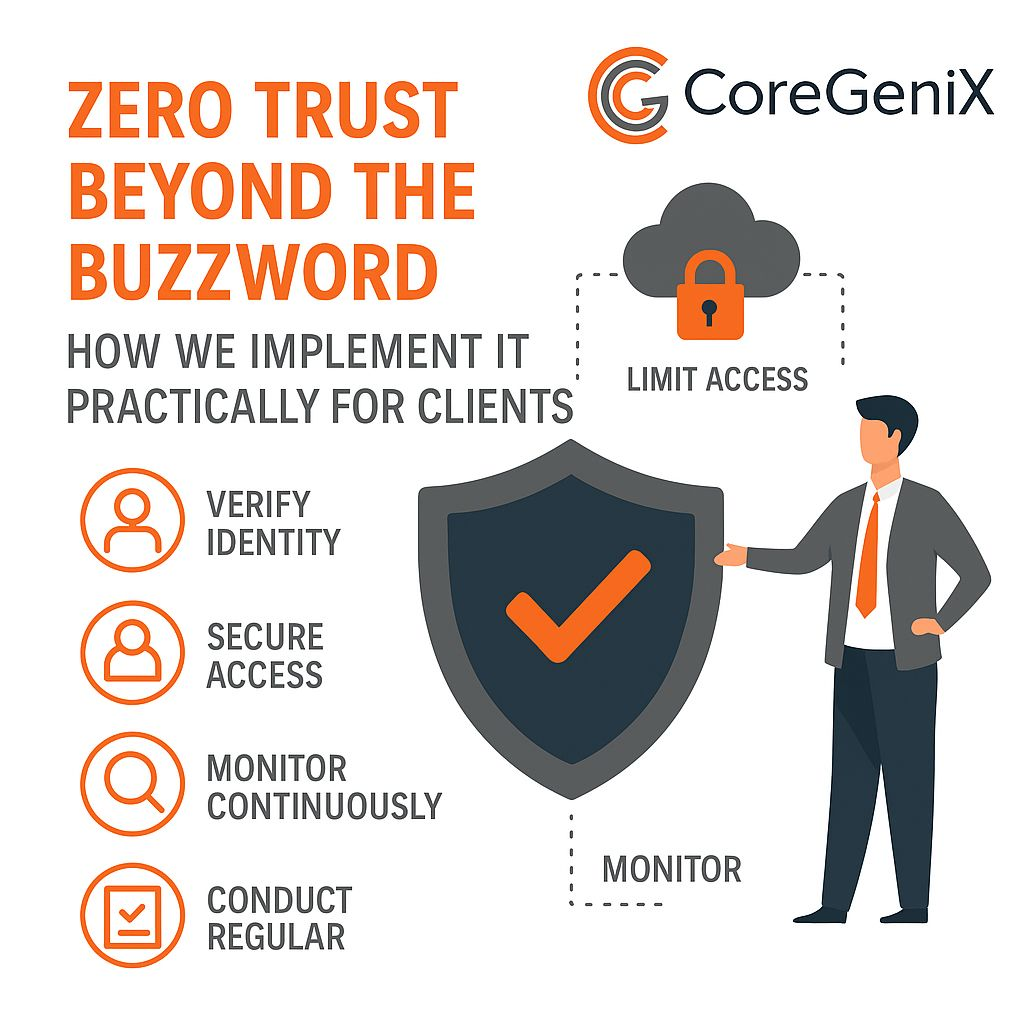
“Never trust, always verify” is a phrase echoed across almost every cybersecurity conversation today. But in real enterprise environments, Zero Trust is not just a framework or a marketing term—it is a fundamental shift in how security is designed, deployed, and sustained.
At CoreGenix, we believe Zero Trust must work in the real world, not just on whiteboards. Our approach focuses on practical transformation that strengthens security without disrupting business operations.
Zero Trust Is a Mindset, Not a Checkbox
Many organisations struggle with Zero Trust because they attempt to implement it as a one-time project. In reality, Zero Trust is an evolving security model that adapts continuously to changing users, devices, and threats.
Our focus is simple: build security that is resilient, adaptive, and operationally aligned.
How CoreGenix Implements Zero Trust Practically
1. Start with Visibility
You cannot secure what you cannot see. Every Zero Trust journey begins with full visibility.
We start by mapping:
- All users and identities
- Devices across cloud and on-prem environments
- Application and data flows
This visibility creates the foundation for access policies based on facts—not assumptions.
2. Identity Is the New Perimeter
Perimeter security is no longer enough. Identity becomes the primary control point.
Our Zero Trust implementations include:
- Multi-factor authentication (MFA)
- Conditional access policies
- Continuous validation of device health, location, and user behaviour
Access is granted dynamically—only when context is verified.
3. Micro-Segmentation Done Right
Micro-segmentation is powerful—but only when implemented correctly.
Instead of locking everything down at once (and breaking workflows), we:
- Start with high-value and high-risk assets
- Phase segmentation gradually
- Align security controls with business operations
This ensures stronger protection without disrupting productivity.
4. Continuous Monitoring & Behavioural Analytics
Zero Trust is never “set and forget.” Continuous monitoring is essential.
Using real-time telemetry and behavioural analytics, we detect:
- Compromised credentials
- Anomalous user behaviour
- Lateral movement attempts
This allows rapid response before threats escalate.
5. Empowering People, Not Frustrating Them
Security should protect users—not slow them down.
Our goal is frictionless security:
- Invisible to legitimate users
- Unforgiving to attackers
When security feels seamless for employees but restrictive for threats, Zero Trust truly succeeds.
Zero Trust Is a Journey, Not a Destination
Zero Trust is not about paranoia—it’s about resilience. It evolves as threats, technologies, and business needs change.
At CoreGenix, we help organisations move away from legacy trust models toward adaptive Zero Trust architectures that actually work in production environments.
Ready to Move Beyond Legacy Trust Models?
Zero Trust isn’t a destination—it’s a continuous journey.
If you’re ready to transition from traditional security to a Zero Trust architecture built for real-world operations, let’s talk.