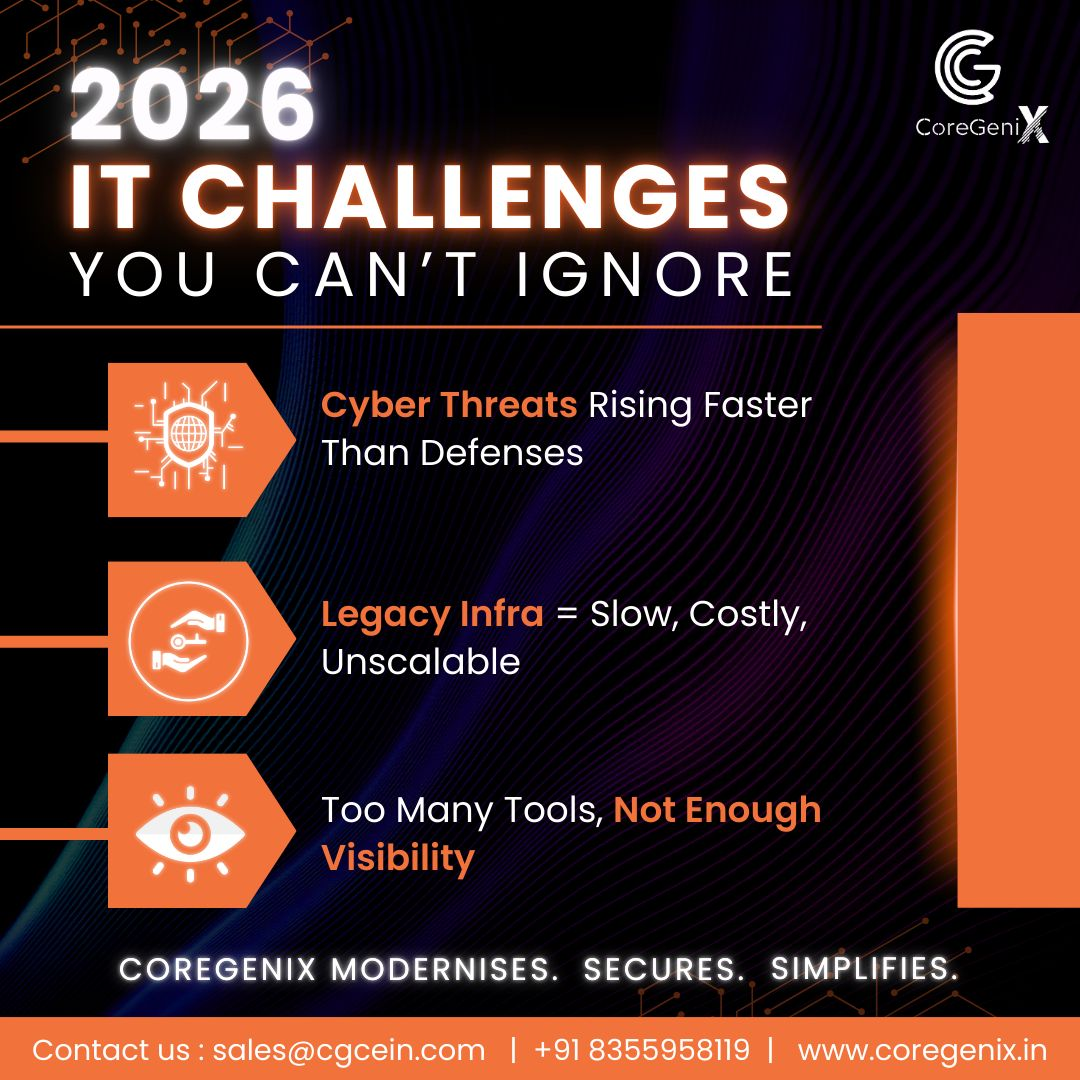
As enterprises move toward 2026, IT leaders are facing a convergence of challenges that can no longer be postponed. Rapid digital expansion, evolving cyber threats, and growing infrastructure complexity are pushing traditional IT models to their limits.
Most organisations are entering 2026 with three critical IT challenges: rising cyber threats, outdated infrastructure, and fragmented visibility across systems. Addressing these issues is essential to maintaining resilience, performance, and business continuity.
The Top IT Challenges Enterprises Face in 2026
1. Cyber Threats Are Rising Faster Than Defences
Attackers are evolving faster than traditional security controls. Advanced threats, automation, and AI-driven attacks are overwhelming perimeter-based defences and reactive security models.
Without continuous monitoring and proactive response, enterprises struggle to detect threats early—resulting in higher risk, downtime, and data loss.
2. Legacy Infrastructure Is Slow, Costly, and Unscalable
Outdated infrastructure is one of the biggest barriers to digital growth. Legacy systems:
- Limit performance and agility
- Increase operational and maintenance costs
- Struggle to support cloud and hybrid workloads
- Create single points of failure
As business demands increase, legacy infrastructure becomes a liability rather than an asset.
3. Too Many Tools, Not Enough Visibility
Many enterprises rely on multiple disconnected tools for monitoring, security, and operations. While tools increase in number, visibility often decreases.
This fragmentation leads to:
- Blind spots across infrastructure and security
- Slower incident detection and response
- Increased operational complexity
- Reactive rather than proactive IT operations
Unified visibility is essential for controlling risk and maintaining uptime in complex environments.
Why These Challenges Demand Immediate Action
Ignoring these challenges puts enterprises at risk of:
- Unplanned downtime and service disruptions
- Security breaches and compliance failures
- Rising operational costs
- Reduced competitiveness in a digital-first market
2026 requires IT environments that are secure, observable, and built for scale.
How CoreGenix Helps Enterprises Overcome 2026 IT Challenges
CoreGenix helps organisations modernise, secure, and simplify IT environments through a unified, proactive approach.
- Modern, cloud-ready infrastructure architecture
- Unified monitoring across IT, network, and security
- 24×7 NOC & SOC operations for proactive response
- Continuous security operations and threat detection
- Simplified IT operations with reduced complexity
By addressing infrastructure, security, and visibility together, CoreGenix enables enterprises to operate with confidence.
Modernise. Secure. Simplify.
2026 will reward organisations that act early. Modern IT environments are no longer optional—they are essential for resilience, performance, and growth.
Ready to uncover your IT blind spots?
Book a consultation with CoreGenix and take the first step toward a secure, modern, and simplified IT environment.